Quantum Pings Library
Pareidolia
- Type
- Concept
- Publisher
- Psychology
- Source
- Wikipedia ↗
Seeing faces in clouds or toast. Pareidolia is apophenia applied to vision, and it is how the brain turns random texture into something that looks like a message.
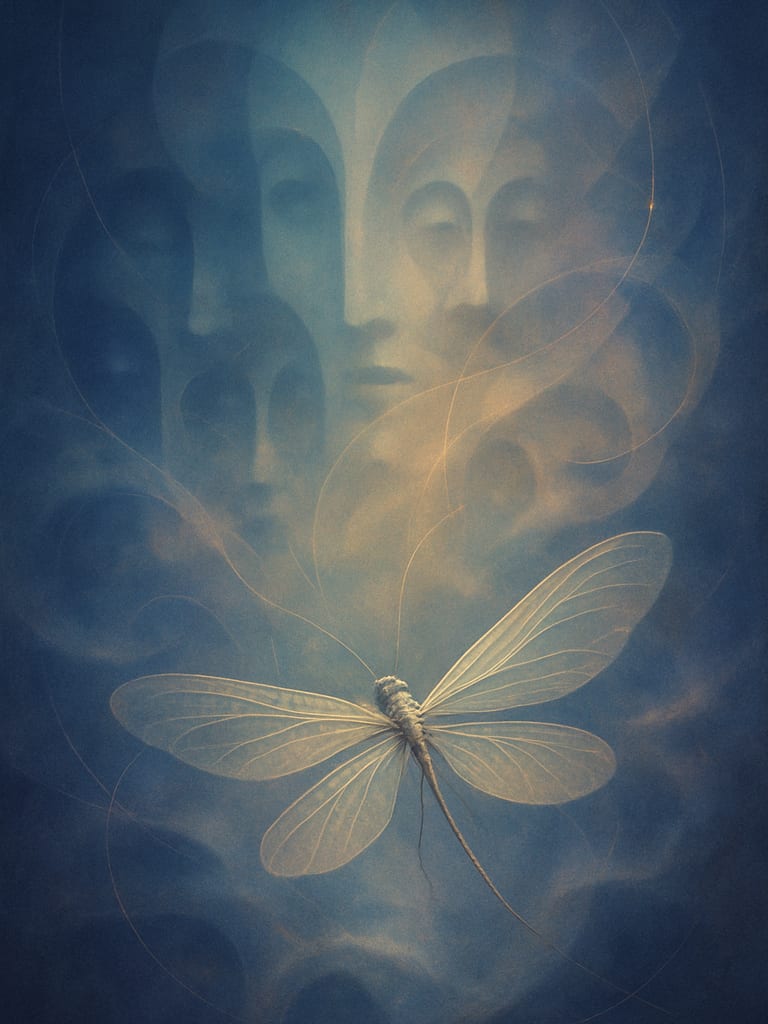
Pareidolia is apophenia with a face: the tendency to see faces, animals, and familiar shapes in clouds, wood grain, toast, and noise. It is the most vivid demonstration that perception is not a passive recording but an active completion — the brain fills ambiguity with whatever it already knows.
That makes pareidolia the skeptic's favorite analogy for synchronicity. A face in a cloud is entirely in the viewer, yet it is perceived as vividly as a real face. The experience of meaning in a coincidence works the same way: the feeling is real, the source is the observer.
The meaning
The fact that we are wired to find faces everywhere is often read as evidence that meaning is fundamental to perception — we do not choose to see it.
The skeptic
Faces in clouds are the clearest possible demonstration that the brain projects meaning onto randomness. The face is entirely in the viewer.
About the source
A specific kind of apophenia: seeing faces, animals, or shapes in clouds, wood grain, and noise.
Key takeaways
- Pareidolia is the visual face of apophenia: faces and shapes in random texture.
- It shows perception is active — the brain completes ambiguous input with meaning.
- It is the standard skeptical analogy for synchronicity: the pattern is in the observer.