Quantum Pings Library
Wolfgang Pauli
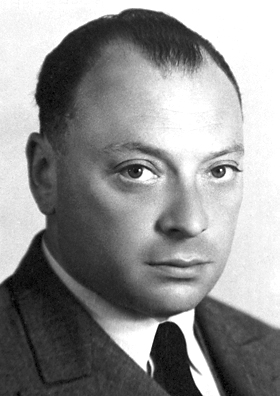
- Type
- Person
- By
- Physicist (1900–1958)
- Affiliation
- Nobel Prize in Physics, 1945
- Source
- Wikipedia ↗
- Published
- 1900
A Nobel physicist who took synchronicity seriously enough to co-author a book with Jung and to keep arguing about it until his death.
Wolfgang Pauli (1900–1958) won the 1945 Nobel Prize in Physics for the exclusion principle and was famous among colleagues for a mind that tolerated no sloppiness — and, in folklore, for the "Pauli effect," the joke that laboratory equipment broke in his presence.
Pauli's place on this shelf comes from the other side of his life: his long correspondence with Jung, collected in Atom and Archetype, in which he treated the psyche–matter question as a live scientific problem. He wrote that future reality would be "neither 'psychic' nor 'physical' but somehow both and somehow neither." That sentence is the closest thing the believer's case has to a physicist's blessing — and the skeptic's reminder that a blessing is not a measurement.
It is my personal opinion that in the science of the future reality will neither be 'psychic' nor 'physical' but somehow both and somehow neither.
The meaning
Pauli's involvement is the single strongest argument that synchronicity is more than a fad: a physicist of his rank treated it as a live scientific question.
The skeptic
Pauli never produced an experiment that linked mind to matter. His interest is evidence of an open mind, not of a real effect.
About this person
Nobel Prize–winning physicist (1945) who spent decades in dialogue with Jung about psyche and matter.
Key takeaways
- Won the 1945 Nobel Prize in Physics for the exclusion principle.
- Co-authored The Interpretation of Nature and the Psyche with Jung (1952).
- His letters to Jung are collected in Atom and Archetype.